Using the 5 Practices to Teach Linear Functions with a Stacking Cups Lesson
Updated: Oct 5
If you’re interested in implementing 3 Act Math or other open-ended math problems, I highly recommend the book 5 Practices for Orchestrating Productive Mathematics Discussions.
The 5 Practices framework helps teachers plan and facilitate productive math discussions so students can share strategies, analyze mistakes, and connect mathematical ideas. In this post, I’ll walk through how I used the five practices during a linear functions lesson using the Stacking Cups activity.
Learning Goal
“To ensure that a discussion will be productive, teachers need to have clear learning goals for what they are trying to accomplish in the lesson, and they must select a task that has the potential to help students achieve those goals…The key is to specify a goal that clearly identifies what students are to know and understand about mathematics as a result of their engagement in a particular lesson.” (Smith & Stein, 2011)
For this lesson, I had two learning goals:
Provide a context for slope and y-intercepts.
Help students understand that linear functions have a constant rate of change and can be represented in multiple ways.
I chose the Stacking Cups activity because it’s my favorite task for introducing linear functions and slope-intercept form.
It aligns perfectly with the structure of linear equations, and students always enjoy the challenge of stacking cups as tall as the teacher. I’m also generally in favor of hands-on math activities, and this lesson provides plenty of that.
Anticipating Student Strategies
“Anticipating students’ responses involves developing considered expectations about how students might mathematically interpret a problem, the array of strategies—both correct and incorrect—that they might use to tackle it, and how those strategies and interpretations might relate to the mathematical concepts, representations, procedures, and practices that the teacher would like his or her students to learn.” (Smith & Stein, 2011)
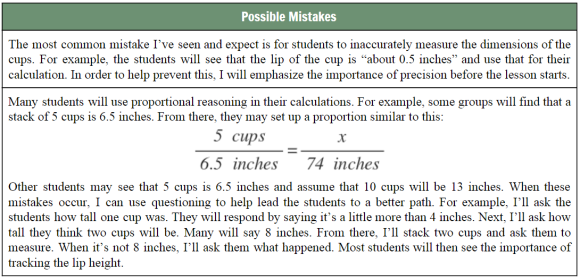
During the anticipation stage, I tried to predict the strategies and mistakes students might make.
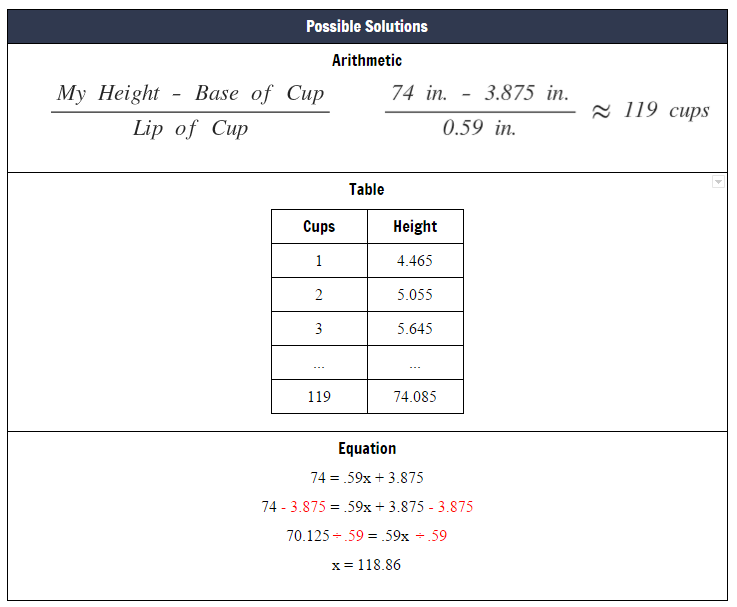
One helpful way to do this is simply to solve the problem multiple ways yourself. As I worked through the task, I thought about:
Arithmetic approaches
Recursive reasoning
Table patterns
Writing equations
Potential misunderstandings about the starting height
To keep everything organized, I created charts listing possible strategies and errors I expected students to use.
Monitoring Student Work
“One way to facilitate the monitoring process is for the teacher, before beginning the lesson, to create a list of solutions that he or she anticipates that students will produce and that will help in accomplishing his or her mathematical goals for the lesson.” (Smith & Stein, 2011)
Once students began working in groups, I monitored their strategies using the list I created during the anticipation stage.
My goal during this time was to:
Identify which strategies different groups were using
Notice any misconceptions
Decide which groups might be helpful for the class discussion
I used a monitoring chart to track which groups were using each strategy.

As the groups worked, I noticed that most students used arithmetic reasoning to solve the problem. However, there was at least one group in each class that wrote an equation.
Selecting Student Work to Share
“The selection of particular students and their solutions is guided by the mathematical goal for the lesson and the teacher’s assessment of how each contribution will contribute to that goal. Thus, the teacher selects certain students to present because of the mathematics in their responses.” (Smith & Stein, 2011)
Since most groups used the arithmetic approach, I selected one group to present this method in each class.
I also chose a group that used an equation, since that strategy moves students closer to understanding slope-intercept form.
Another factor in my selection process was participation. I try to rotate presenters throughout the year so that as many students as possible have the opportunity to be the “expert” in front of the class.
Sequencing the Presentations
“Having selected particular students to present, the teacher can then make decisions regarding how to sequence the student presentations. By making purposeful choices about the order in which students’ work is shared, teachers can maximize the chances of achieving their mathematical goals for the discussion.” (Smith & Stein, 2011)
For sequencing, I started with the most common strategy.
This is a recommendation from the book that I really like because it gives the largest number of students an entry point into the discussion. When students see a method similar to their own, they immediately become more invested in the presentation.
Since most groups used arithmetic reasoning, that strategy was presented first.
After that, I had the group that used an equation present their method. My goal was to highlight their thinking, especially how they determined where each number belonged in the equation.
This helped move the class toward a deeper understanding of slope and the y-intercept.
Connecting the Mathematical Ideas
“Rather than having mathematical discussions consist of separate presentations of different ways to solve a particular problem, the goal is to have student presentations build on one another to develop powerful mathematical ideas.” (Smith & Stein, 2011)
After the presentations, I guided students through a connection handout.
This is my preferred method for ensuring the learning goals are actually met.
The handout begins by highlighting the key strategies that were shared. Then students work through a series of guiding questions designed to help them:
Compare solution methods
Identify patterns in the strategies
Connect the activity to the larger ideas of the unit
I also included big mathematical ideas about linear functions, which I adapted from materials created by New Visions for Public Schools.
These connections help students prepare for developing procedural fluency with slope-intercept form in the following lessons.
Materials for the Stacking Cups Linear Functions Lesson
Here are the materials mentioned in this post and used during the lesson:
Final Thoughts on the 5 Practices
Using the 5 Practices framework can make 3 Act Math lessons and other open-ended math tasks much more effective.
By intentionally anticipating strategies, monitoring student thinking, and carefully sequencing presentations, teachers can turn student work into meaningful discussions that deepen understanding of concepts like linear functions, slope, and the y-intercept.
Reference
5 Practices for Orchestrating Productive Mathematics Discussions
Smith, M., & Stein, M. (2011). 5 Practices for Orchestrating Productive Mathematics Discussions. Reston, VA: National Council of Teachers of Mathematics


Comments