How to Use Card Sort Activities in Math Class
I made a shift to teaching exclusively with students sitting in groups late in my classroom career, and it was one of the best changes I made.
But if students are going to sit in groups all class, we need activities that are actually groupwork worthy. Not every activity has to be completed as a group, but I found that planning each class with collaboration in mind made groupwork much more natural.
One of my go-to collaborative activities is the classic card sort.
Card sorts are simple to implement, work especially well with mathematical concepts that have multiple representations, and create opportunities for students to explain their thinking and analyze mistakes together.
What Is a Card Sort?
A card sort activity gives students a shuffled set of cards that match in some meaningful way. Working in groups, students analyze the cards and sort them into matching groups.
The cards don't necessarily look alike. Instead, they represent the same mathematical idea in different ways.
For example, in this sample card sort from our Linear Equations unit, students work with graphs, tables, and different forms of linear equations. Cards A and D match because the coordinates in the table are represented on the graph of the line.

Card sorts can have different structures:
Each card may have exactly one match.
Some cards may match multiple cards.
Some categories may contain more cards than others.
Students may need to create missing cards themselves.
In most cases, I have students work in groups of 2–4 students to sort the entire deck. The real value isn't simply getting the cards into the correct groups. It's the mathematical conversation that happens while students decide why cards belong together.
How to Prepare a Card Sort
A little preparation makes card sorts much easier to manage.
1. Prepare one deck per group
Cut out enough decks for the largest class you'll teach. I also recommend keeping a few extra decks available in case cards get lost, damaged, or accidentally written on.
I like to store each deck in an individual Ziploc bag so the cards stay organized.
2. Complete the sort yourself
Work through the entire card sort before using it with students.
This helps you:
Become familiar with the intended matches
Anticipate misconceptions
Identify cards that may cause confusion
Prepare questions to ask while monitoring groups
I also recommend carrying an answer key while you circulate around the room.
3. Prepare an individual student handout
Even though the activity is collaborative, I like every student to have something to record their work on.
The handout can include a table for students to record their matches, along with analysis questions or additional practice problems.
This gives students an individual record of their thinking and keeps students productively working if their group finishes before the rest of the class.
How to Implement a Card Sort in Class
The most important implementation tip is simple:
Explain the activity before you give students the cards.
If you hand out the cards first, students will immediately start looking through them instead of listening to your directions.
Instead:
Explain what students are going to do.
Show an example if necessary.
Check that students understand how cards should be matched.
Give each group its deck.
Release students to begin sorting.
Once students begin, circulate around the room and listen to their conversations.
Don't fix mistakes too quickly
One of the best parts of a card sort is hearing students debate which cards belong together.
If a group has an incorrect match, resist the temptation to immediately tell them they're wrong. Instead, ask questions that encourage them to explain their thinking.
You might hear a student say, "I think these two go together because..."
That's exactly the conversation you want.
As you circulate, look for common incorrect matches. These can become excellent whole-class error-analysis opportunities.
If several groups make the same mistake, you can pause the activity and discuss the misconception with the entire class.
You can also save particularly important cards for a brief discussion after the sort. Ask students to explain why those cards belong together and what mathematical connection they represent.
Designing Better Math Card Sorts
Not every mathematical concept is equally suited to a card sort.
I especially like using card sorts for concepts that can be represented in multiple ways.
For example, a linear equations card sort might include:
Graphs
Tables
Standard-form equations
Slope-intercept equations
Other representations of the same relationship
This makes the activity more than a matching exercise. Students have to synthesize multiple representations and identify the mathematical connections between them.
Leave some cards blank
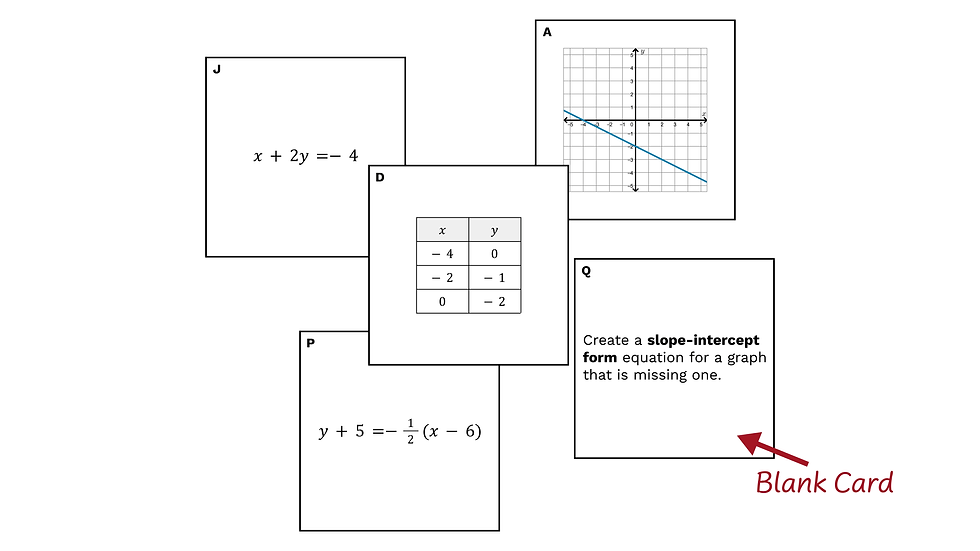
Another strategy is to intentionally leave some cards blank.
Students then have to create their own card to complete a match or category.
This adds another layer of challenge because students aren't simply identifying a relationship; they have to generate a representation that satisfies it.
Label every card
Give each card a letter or number.
This makes discussion much easier.
Instead of saying, "The graph with the line going through those two points," a student can say, "I think Card D matches Card A because..."
It also makes whole-class discussion and error analysis much more efficient.
What Should Go on the Student Handout?

I like to give students a table where they can organize their matches. Depending on the activity, the table headers can be predetermined or left blank for students to identify the categories themselves.
Whenever possible, include important mathematical representations directly on the handout rather than asking students to redraw them. This saves time and creates a useful reference students can keep.
The back of the handout can be used in several ways:
Ask students to analyze an important match.
Have students explain a common incorrect match.
Include one or two problems related to the card sort.
Provide additional practice for students who finish early.
For example, you might show students a common incorrect pairing and ask:
"Why might someone think these two cards match? What evidence shows that they don't?"
This turns the card sort into an opportunity for mathematical reasoning and error analysis.
When Should You Use a Card Sort Activity?
I generally use card sorts after students have had time to learn the content.
For that reason, I tend to use them midway through a unit or toward the end of a unit rather than introducing a brand-new concept with a card sort.
The goal is for students to collaborate, which means each student needs enough background knowledge to contribute.
If students haven't had enough time to learn the content, groups can easily become dominated by the one or two students who understand the concept most quickly.
Card sorts work particularly well as a way to connect ideas, reinforce learning, and reveal misconceptions after initial instruction.
Where Can You Find Math Card Sorts?
If you're looking for ready-to-use card sort activities, our Algebra 1 and Geometry curricula include card sorts throughout the lessons.
Use the Routines filter on either curriculum page to find lessons that include card sort activities.
If you're new to card sorts, start with one concept that has multiple representations, prepare one deck per group, and give students plenty of time to explain why their cards match.
The goal isn't just to sort the cards correctly.
The goal is to get students talking about the mathematics.


Comments