Estimation Challenges: My Routine for Starting Math Class
- 6 days ago
- 4 min read
One of my favorite ways to unlock curiosity in math class takes just a few minutes.
It's called an estimation challenge.
For years, I put an estimation challenge on the projector as students walked into class. They made a guess, completed their warm-up, and then we paused to share estimates before revealing the answer.

It was simple. No elaborate setup. No special materials.
And students loved it.
If I ever forgot the daily guess, they would ask, “Where's the estimation challenge?”
That's when I knew it had become part of our classroom routine.
My Estimation Routine

The routine is simple:
1. Display the challenge
Project an estimation challenge as students enter the room.
Students write down their estimate on their warm-up paper. Everyone commits to a number before anyone shares.
Then they move on to the rest of their warm-up.
2. Give them 3–5 minutes
The estimation challenge doesn't need to take over your class.
Let it sit in the background while students settle in and complete their normal warm-up.
3. Share the guesses
After a few minutes, stop the class and ask for volunteers to share their estimates.
Sometimes I write several guesses on the board, from lowest to highest.
This creates a little suspense.
4. Keep a poker face
This might be the most important part.
When students share, don't react to whether their guess is good or bad.
I usually just say:
“Nice.”
or
“Okay, cool.”
That's it.
If you raise your eyebrows when someone gives a great estimate, you've just given away information. If you laugh at a wild guess, you've made it less safe for the next student to participate.
Keep a straight face, and every estimate stays in play.
5. Reveal the answer
Finally, reveal the answer.
Whenever possible, I like the reveal to be an image or video rather than simply displaying a number.
Students get to see how close they were, and then you move on with the day's lesson.
That's the whole routine.
A few minutes. No prep. And a little curiosity every day.
Why I Like Estimation Challenges
The goal isn't really to teach estimation.
It's to get students to wonder.
If I tell students there are 201 cubes in a pile, they probably don't care very much.
But if I show them the pile and ask, “How many cubes do you think are here?”, suddenly everyone has a number in their head.
Maybe they guessed 100.
Maybe 300.
Maybe someone guessed 201.
Now the answer matters because students have something to compare it to.
The estimate gives the answer somewhere to land.
And unlike a quiz, there's no pressure to be right. Students are simply making a prediction and seeing what happens.
Your Estimation Challenge Doesn't Have to Match Your Lesson
This is another reason I love this routine.
Your estimation challenge doesn't need to be connected to the lesson you're teaching.
If you're teaching linear equations, you don't need an estimation about linear equations.
If you're teaching geometry, you don't need a geometry estimation.
The goal isn't to accomplish a specific learning objective. The goal is simply to start class by getting students thinking and curious.
That makes estimation challenges incredibly easy to use nearly every day.
Try a Daily Overview Challenge
Some of my favorite estimation challenges are inspired by satellite images from around the world.
For example, you might show students a satellite image of a bus storage facility and ask:
“How many school buses are in this picture?”

After revealing the answer, you can take the curiosity one step further. Since Daily Overview gives the exact coordinates of their images, you can pull it up on Google Maps.
I like to have students guess what location in the world the image is from before revealing the map. Then, you can open the map and zoom out to show its actual location among the continents.
You Don't Have to Make Them Yourself
The good news is that you don't have to create hundreds of estimation challenges on your own.
Estimation 180, created by Andrew Stadel, has more than 200 visual estimation tasks that teachers can use to build number sense and mathematical conversations.
We've also created our own collection at When Math Happens.
175+ Free Estimation Challenges
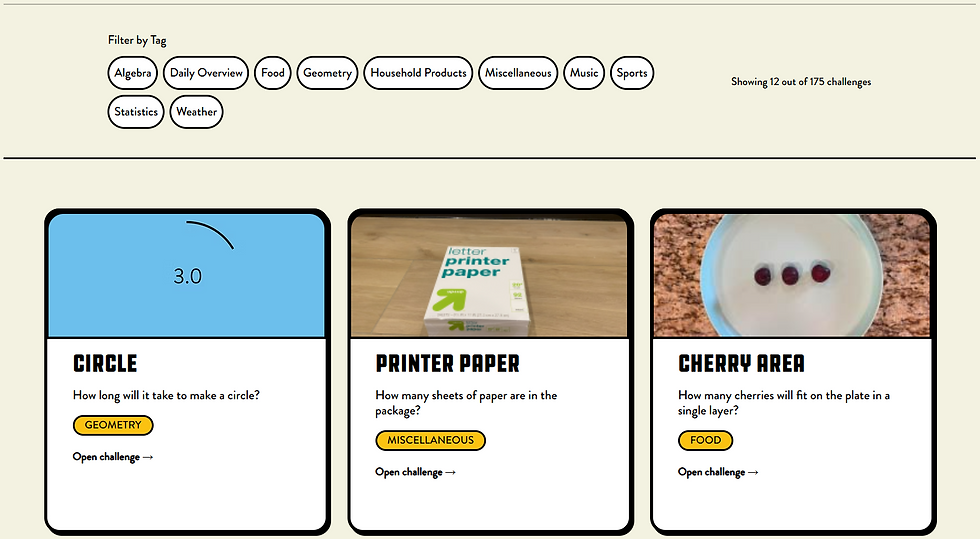
Our Estimation Challenges page has more than 175 challenges (and counting) that are ready to use, including a bunch of Daily Overview challenges.
No prep. No logins. Just project a challenge and let your students guess.
And estimation isn't just a standalone warm-up on When Math Happens. It's also embedded throughout our Algebra 1 and Geometry curriculum.
Students estimate before calculating, make predictions, and develop the habit of asking:
“Does this answer make sense?”
That's the bigger goal.
Not just getting students to estimate.
Getting students to wonder.
So the next time you're looking for an easy way to start math class, put an estimation challenge on the screen.
Give students a few minutes.
Let them guess.
Keep your poker face.
Then reveal the answer.
That's it.
Sometimes a few minutes is all it takes to get curiosity started.


Comments